What does writing with AI actually mean?
Producing words is now effortless. Writing and thinking, still isn't. (featuring: Shakespeare)

There are times when writing without the help of AI, another person, and nothing aside from pen & paper, is best for an author and their output. That choice is one for the author to make.
This piece attempts to define what it means to “write with AI” (hint: there are multiple definitions), the options available to the author, and what that looks like in practice. It thinks through some of the parts of writing that AI can’t do (well, yet).
Anyone should feel able to read this as part of a broad target audience, including:
AI gurus and evangelists
Those with no experience and feelings of being behind in adopting AI
Those rolling their eyes when hearing the word “AI”
It’s easy to write something with AI
Written content1 is the fastest and most scalable way to transfer high-quality knowledge from human brain to human brain. What are the alternatives?
Video: visuals unlock new ways to share, but often with a high cost of creation. Results are linear in output (you sit through the whole thing to process it)
Audio files: lower creation cost than video, but still a linear output and may lead to rambly/poor recipient experiences, unless scripted
An actual conversation: frictionless, fast, but scales poorly. Knowledge might evaporate afterwards (unless using AI recorders and note-takers)
Meanwhile, a great piece of written content is scalable, shareable and lowers the barrier to create and consume. It’s simple for AI to summarise, expand and challenge as you please.
After listening to an insightful podcast, watching an inspiring video, or having a useful discussion, the first thought for many is still to “write that down”. For us, writing is thinking. Written content is so powerful, it’s what’s brought about the advent of LLMs in the first place.
These LLMs have made it undeniably simple for us to produce written content in seconds, rather than hours. Previously, limiting factors of producing this content would be speed and clarity of human thought, and the mechanics of putting pen-to-paper or finger-to-key.
Today, limiting factors may be token and context window sizes, thinking of prompts, and one’s ability to skim-review outputs. As a result, the question going around for all forms of writing:
“why can’t AI just do it?”
It’s one I’ve been asked many times at my workplace2 . Let’s explore this question.
Two methods of AI writing
The act of writing is officially defined as -
“the activity or skill of marking letters, words, or other symbols on a surface, typically paper, with a pen, pencil, or similar implement” - Oxford dictionary
But we don’t celebrate Aristotle, Kant or Shakespeare’s abilities to apply ink to paper. Humanity has been influenced by their ideas and thoughts. This is still the most difficult part about writing, and the part we might find easiest to overlook today.
I think there are broadly two methods of *writing with AI* in today’s world. I’ve attempted to depict these with diagrams below (🤖 = AI , 🧠 = human):
Method 1. AI is the writer, you are the editor
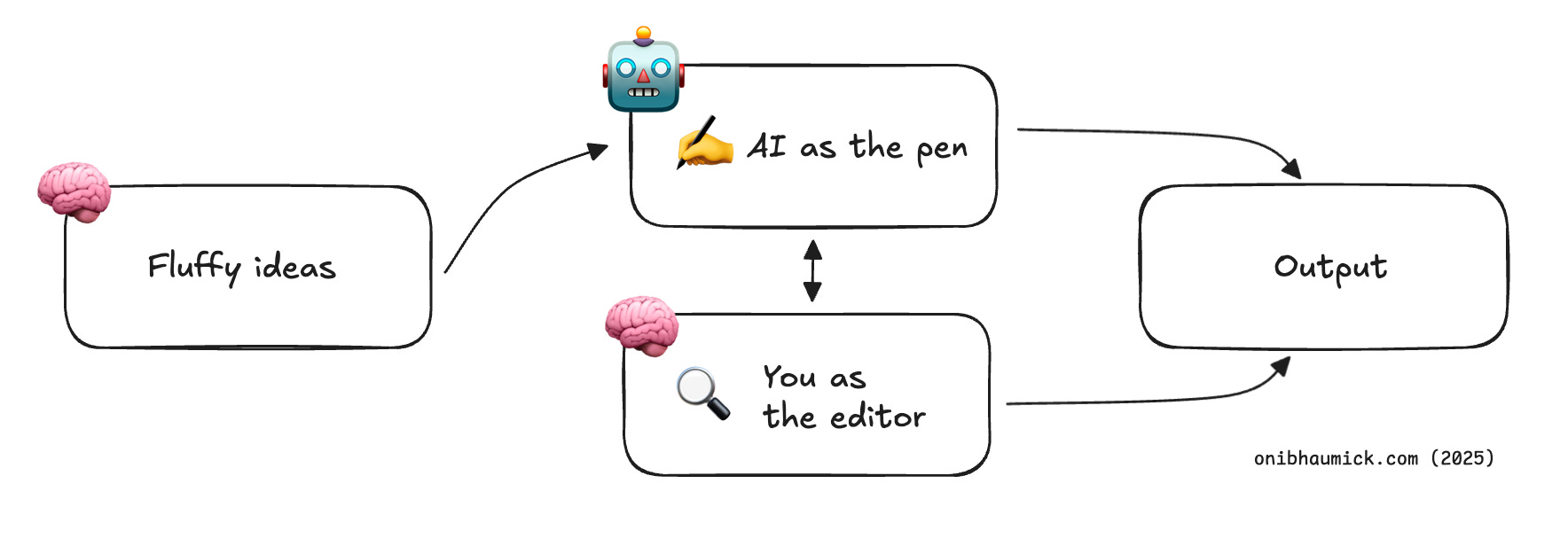
A human can take half-formed ideas and a general direction, type it into a prompt and let AI take the first pass. The human acts as an editor by providing comments to chisel away at the text AI produces, honing it down to something they are satisfied with.
Method 2. You are the writer, AI helps with hard thinking
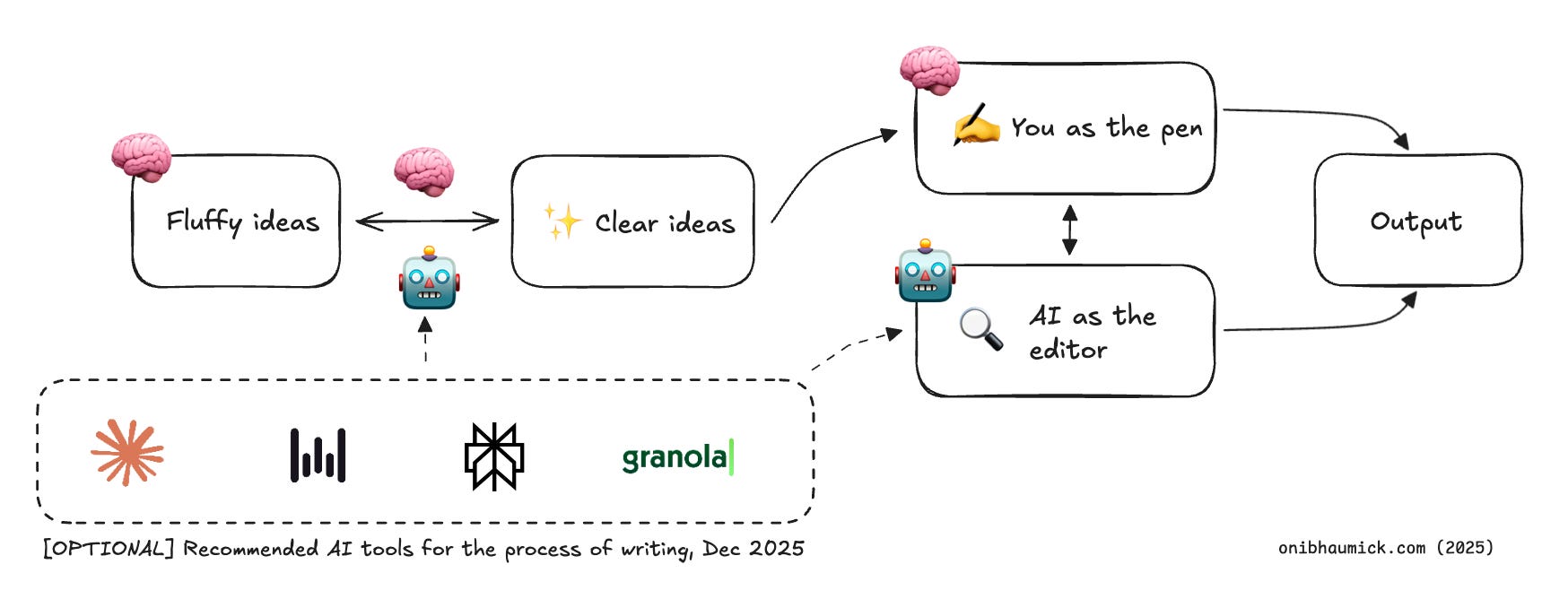
Half-formed thoughts can be shaped into clear ideas through (usually painful and time-consuming) judgement, creation and iteration. A human seriously considers ideas that would never make the final cut3, takes time to ponder, and learns more about what they are trying to say. Here, one can use AI tools. I might use combinations of those listed below4, depending on the circumstances:
Review outputs and bounce ideas with Claude or [insert preferred AI model]5
Share your sentence, paragraph or entire document with an AI model, along with your reservations. For example, asking if “there are gaps or inconsistencies in arguments such as …” or “if sections feel too wordy”
Chisel away at specific ideas before you write, by treating AI as a sparring partner to challenge and vet your thoughts
These are all extra perspectives for your consideration. Treat AI as an advisor who may be enthusiastically wrong, not an instructor who is always right
Get down your stream of consciousness with AI voice-to-text dictation tools like Wisprflow (or Superwhispr)
Use this tool to record your voice, and draft at the natural speed of speech, instead of the speed of your fingers.
It feels like having a conversation with your own ideas, and gives space to have drafts of drafts, vs. funnelling only more crystallised thoughts on paper
This is most impactful when combined with use of AI in the point above
AI search tools like Perplexity or [insert preferred research tool]
Investigate, prove and disprove your theses with reliable, source-based search
AI meeting note takers like Granola (there are many others today)
Trust that a note-taker better than you (yes!) is diligently keeping a transcript during a meeting or conversation, allowing you to focus on conversation
Interrogate that transcript when writing afterwards, to recall, question and challenge what was discussed, and turn it into written content
With clarity on ideas, a human can begin the process of writing and improving drafts, using any of the AI tools mentioned above throughout this process.
When to use each method of AI writing
When to use Method 1
When speed is more important than quality e.g., pumping out short-form content and captions across LinkedIn, X, etc.
When you already have clarity on what you are saying, and it is simple. This is extremely rare for long-form content, and may be possible with short-form content (LinkedIn, Twitter etc.,)
If Shakespeare wanted to promote his latest performances on X and LinkedIn with some eye-catching prose to tease, I bet he’d love to ask ChatGPT to have a first pass.
When to use Method 2
If ideas are complex, layered and have nuances
When you want/need to feel proud about an output, and claim ownership over it
When you want to enjoy the journey of creation, with its requisite growth and learning
When you need faultless conviction about your ideas, to be able to defend, justify and expand upon critique from others
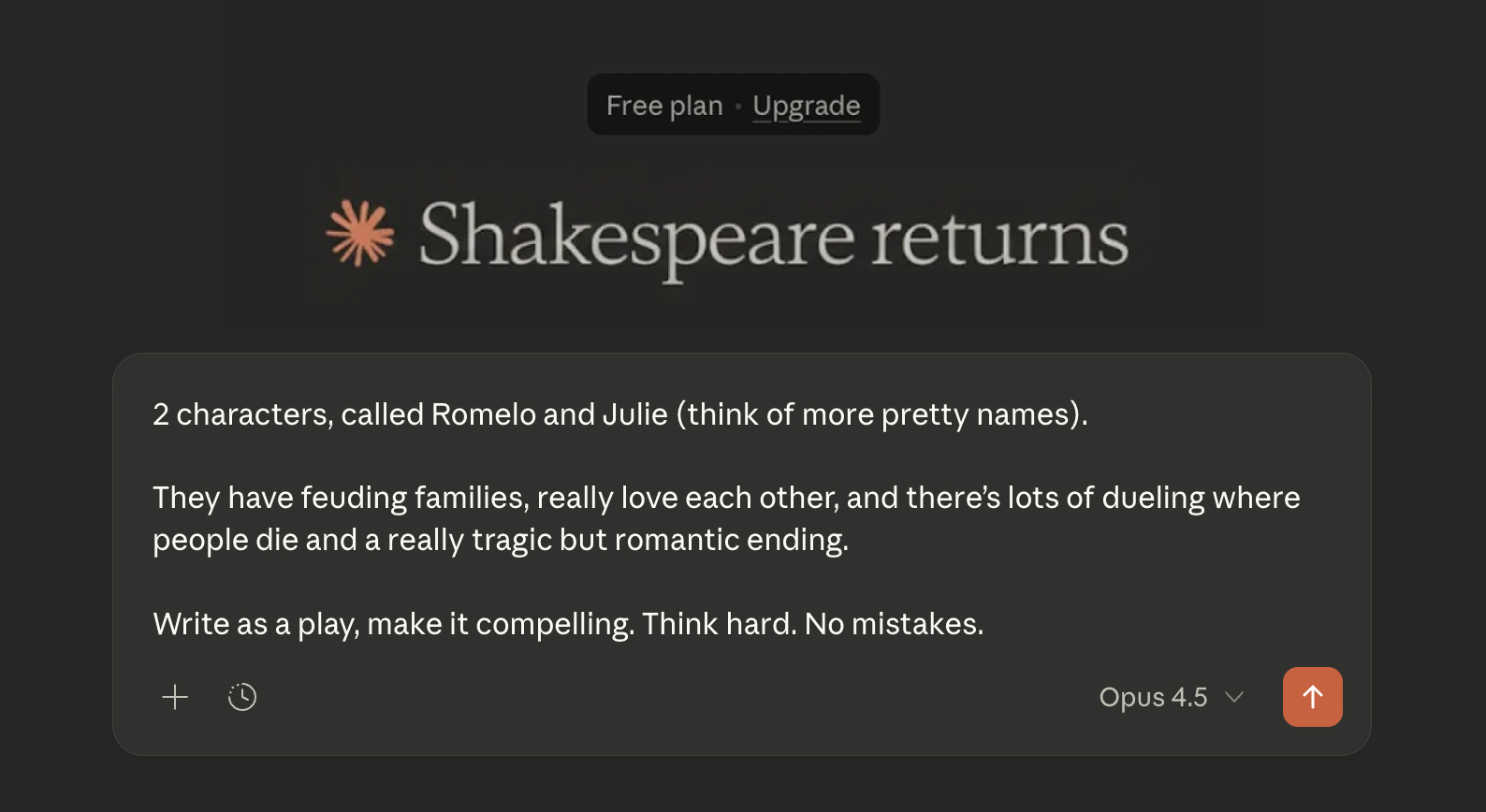
Method 2 is deliberately named “AI helps with hard thinking” vs. “AI replaces the hard thinking”. Shakespeare could not prompt the below and seriously expect an LLM to shape the Western ideal of love as something worth dying for in centuries to come:
“2 characters, called Romelo and Julie (think of more pretty names). They have feuding families, really love each other, and there’s lots of dueling where people die and a really tragic but romantic ending. Write as a play, make it compelling. Think hard. No mistakes.”
- Shakespeare’s prompt
But would Shakespeare have appreciated using Perplexity to research how masked balls for Italian nobles in Renaissance Verona worked, Wisprflow to dictate his vision of the iconic balcony scene, and Granola to record detailed critiques from theatre colleagues on his earliest drafts? I think so.6
These tools might have sped up Shakespeare’s process and given him more space to reflect, but they would not replace his central voice. Writing high-quality, complex content with a clear voice, still requires the author to be certain of what they are trying to say, which is itself an outcome consuming time and effort.
Through this struggle of shaping fluffy ideas into clear ones, an author earns genuine conviction over their choices. They understand the pivots and dead-ends that led to the final output, and can engage with critique deeply, rather than defensively or at a surface level. They are able to both enjoy and hate feeling challenged, wrong, inspired, and arriving at new ideas.
How I wrote this article
I used Method 2 to write this article. To be clear, this means I spent a lot of time re-drafting, refining and grappling with ideas and my own writing. These are my ideas, and my voice, and the product of my typing.
Along the way, I’ve also used AI to some benefit in the following ways:
Claude to test ideas7: Towards the start, when I was most unclear about central ideas in this article, to test my partially formed theses before typing
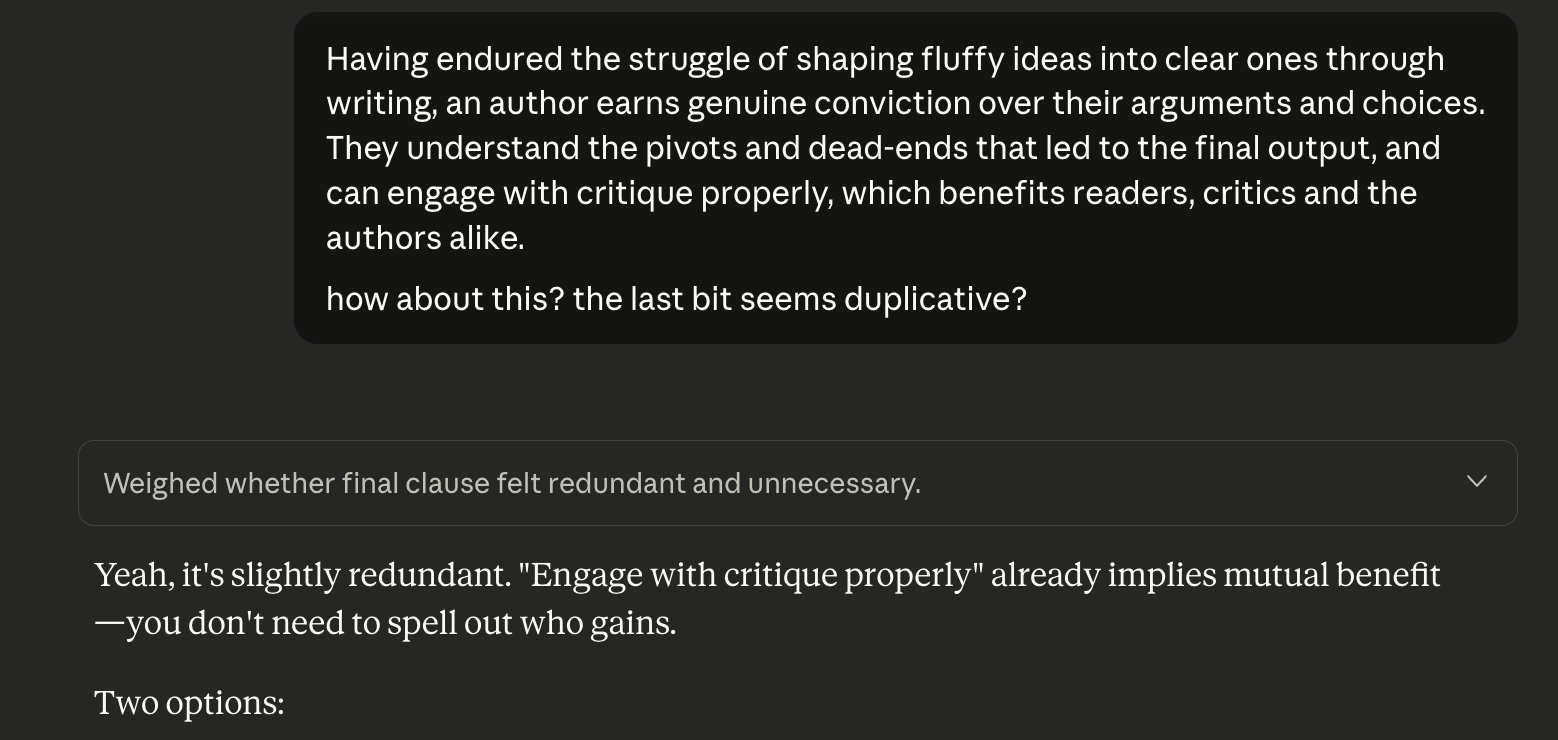
Claude to review content8: Towards the end, when I had reservations on the length, readability and purpose of sections, and wanted another perspective
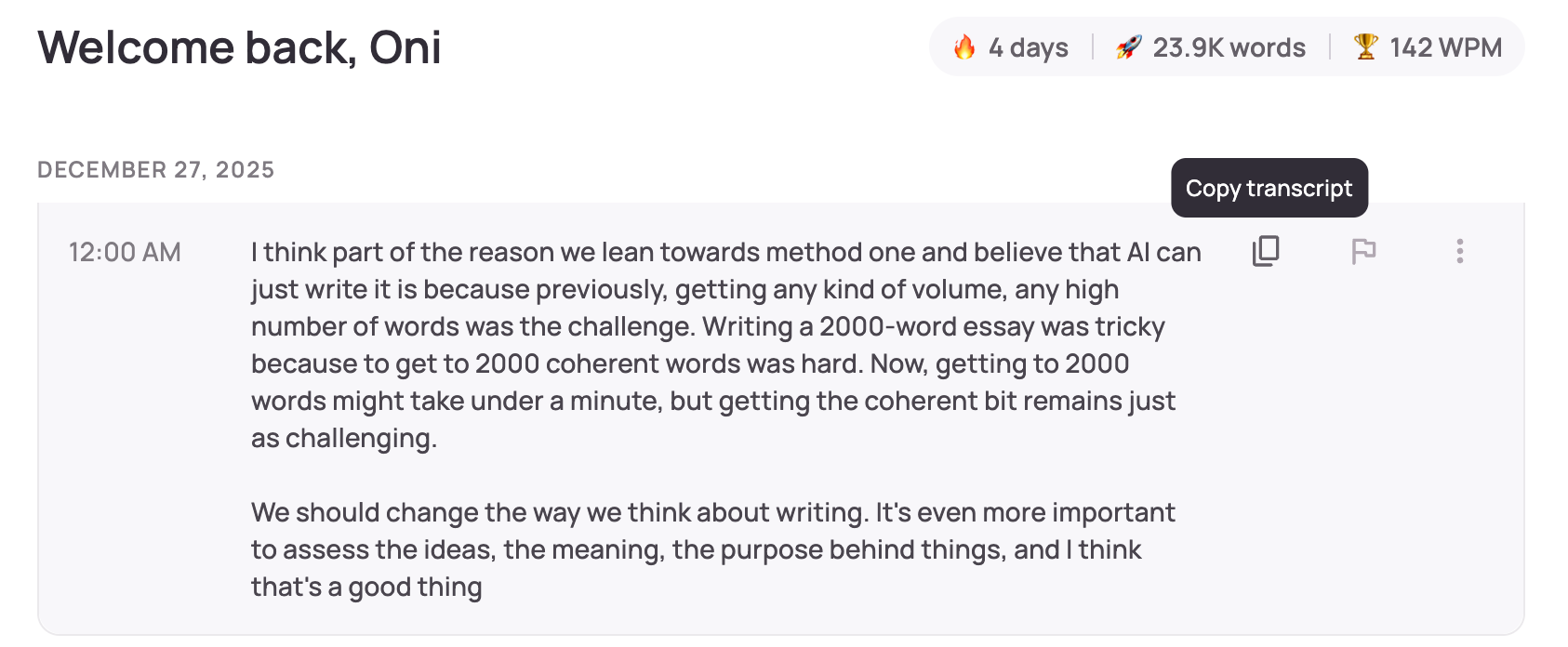
Wisprflow to record my voiced streams of consciousness9: In moments throughout, to record sparks of unrefined ideas
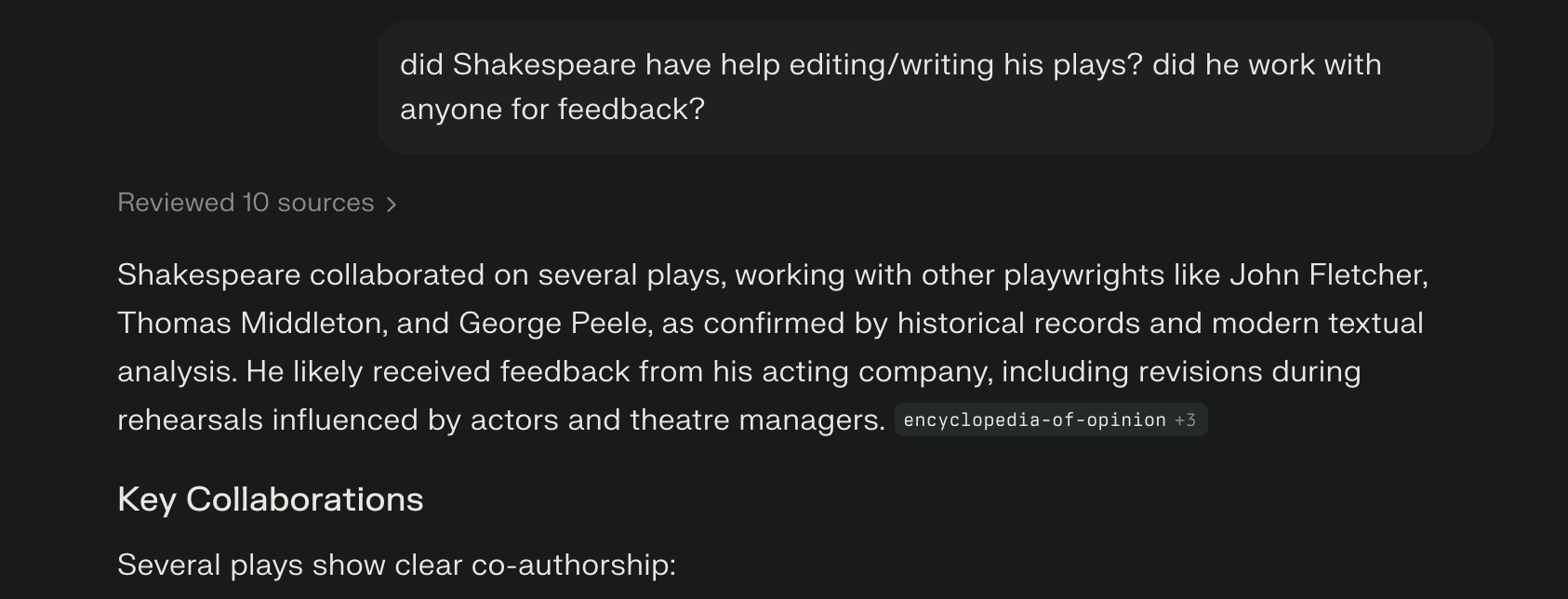
Perplexity for research10: Very little, mainly to check Shakespeare references
Note: I’ve provided images in footnotes to show ‘using AI’ looked like in practice, on the screen, for me. Seeing images of AI interaction may be of more help than my attempts to describe it with words or diagrams, for those interested
I also received feedback from close friends and family on final drafts, which required more patience. Their feedback was different to AI, and far more brutal. Inevitably, real audiences will get bored, skip or misread large sections of writing. Understanding where this happens with human reviewers is worthwhile.
Getting meta and testing AI as a writer
Below, buried in footnotes11, is an alternate version of this article generated with AI being the primary writer, riffing from my fluffy prompts (Method 1). This was 30x faster to create. I provided some editorial12 and formatting advice (e.g., remove em dashes, remove AI-sounding negations).
My assessment: Claude’s version has some neat, refined sentences, but it seems to make one point over and over again, rather than taking the reader on a journey with a narrative. It will leave less of a lasting impression on a reader. The voice also seems annoyingly ‘AI-like’ with characteristically punchy and self-assured sentences, despite attempts to correct this. Overall, this is not a fair and scientific experiment, as I didn’t put nearly as much effort into editing the AI-written piece. I felt very unmotivated to challenge & improve something which I felt very little ownership over.
Some other parting thoughts
“Why would I bother reading something if you couldn’t be bothered to write it?” - many people
I suspect that your eyes regularly glaze over clearly AI-generated text. I do this too, and if I happen to read something before realising it’s AI-generated, I don’t actually mind - as long as the content and ideas are interesting or novel (unfortunately, this is not frequent).
Changing how we think about reading and assessing quality
For most of us, pre-AI, we associated volume as a proxy for effort (and therefore quality). If someone wrote 2000 words, they had to sit with it and think through something. AI has broken this heuristic, since we can now see 2000 words which might cumulatively represent the 60 words of thought put into a prompt.
So when one asks “why can’t AI just do this?”, they should acknowledge that whilst AI can produce as many words as they want, what matters are the ideas and substance behind these words. If these meet the benchmark, it might not matter who did the writing.
Things might significantly change
LLMs have improved rapidly and will continue to. We should expect and prepare for capabilities to dramatically change (whether it’s LLMs or AGI and superintelligence). I’m curious about how this article’s central POV will hold up with time.
I hope this article provided some food for thought, and shared novel ideas for those who have yet to use AI in the ways suggested above. More than that, I hope it put into words why writing as a process is still very hard today, can still lead to wonderful pieces of work and knowledge, and is still worth the effort.
Concerns all types writing (legal, literary, creative, academic, marketing copy etc.). The specifics vary for each type of content, but the core tension discussed in this article, between AI-as-a-writer and AI-as-a-thinking-partner, holds across all forms
Where must think along these lines, as we build a product at the edge of what’s possible with AI today.
What new things did Harry Potter and his friends get up to, in the alternate stories J.K. Rowling wrote in her head, before deciding upon the versions now manifest across 7 books and 8 movies? How many assertions and ideals did Karl Marx abandon or augment, before deciding upon the ones which sparked global revolutions and economic upheavals?
This is from personal experience. There are certainly more tools out there today, and I will certainly change what I use and how I use it, over the course of 2026 and beyond. The best thing one can do here is keep on experimenting
Use Projects across AI tools to organise chats into one place with curated knowledge and context. This speeds up idea generation from sources you trust
Would Shakespeare have also told me to f*** off, if I suggested that he share the raw scripts of Hamlet with Claude, for feedback? Perhaps. (For context, it is a mythic belief that the tragic loss of Shakespeare’s 11-year old son, Hamnet, inspired the writing of Hamlet 4 years later, and provided a way to memorialise and process grief).
Example use of Claude to test ideas: Towards the start, when I was most unclear about central ideas in this article, to test my partially formed theses before typing
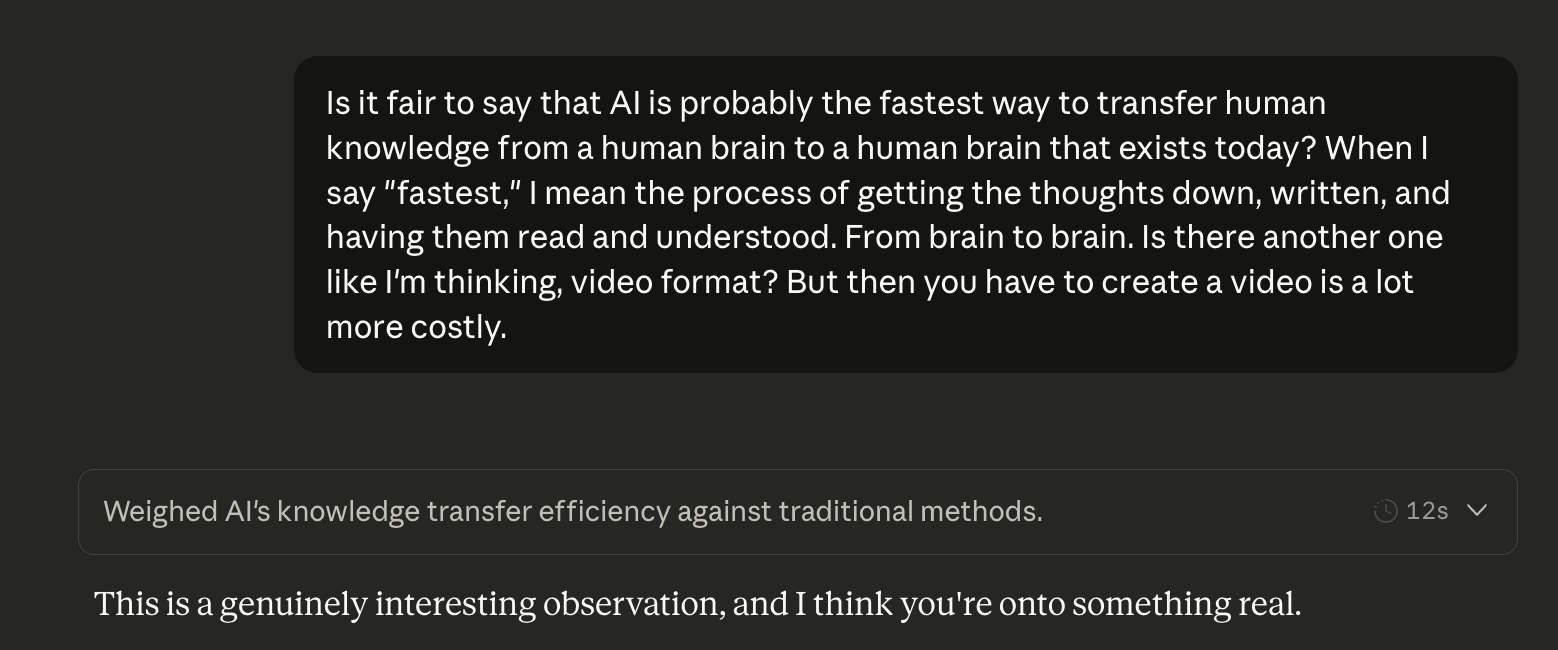
Example use of Claude for review:
Example transcript from use of Wisprflow to record my voiceovers of unrefined ideas:
Example use of Perplexity to fact-check and research:
Version of this article generated by AI-led writing (Claude):
“The Outsourcing Problem
Writing is not transcription. This is the thing most people get wrong.
We imagine that thinking happens first, fully formed ideas appearing in our minds, and writing happens second as a recording process. But that’s backwards. The writing is the thinking. The struggle to finish a sentence forces you to ask what you actually mean. The act of structuring an argument reveals whether you have one. When you try to explain something simply, you discover the gaps in your understanding.
This is why writing is hard. The typing is easy. The clarity is hard. You’re not recording thoughts. You’re generating them through the act of trying to articulate them.
When you let AI write for you, you skip this process. You give it a direction, some bullet points, a rough sense of what you want. The AI fills in everything else: the phrasing, the structure, the connective tissue, the specific claims. It turns your half-formed intuition into a finished piece.
But that finished piece represents the AI’s interpretation of your intuition. Not the refined version of it. You skipped the refinement. You outsourced the part where you figure out what you actually think.
The result is text that you can’t fully stand behind, because you didn’t actually produce it. You provided the seed. The AI grew something from that seed. What grew might be close to what you meant, or it might have drifted in ways you don’t even notice. You’ll read it back and think “sure, that works.” But “that works” is not the same as “that’s what I think.”
People tell me AI writing is really good now. They’re right. It’s fluent, structured, professional. It handles grammar and flow better than most humans. It can produce a clean first draft in seconds.
But fluent and structured isn’t the bar. The bar is: does this say something true?
Most AI writing produces the shape of insight without the insight. It knows what thoughtful prose looks like, because it’s trained on enormous quantities of it. So it generates something that resembles thoughtfulness. The right sentence rhythms. The appropriate hedges. Conclusions that sound wise.
You can feel the difference when you read it. A smoothness. Nothing you’d object to, nothing that snags. And that’s the problem. Good writing has friction. It has the specific weight of someone who actually worked something out. AI writing is frictionless in a way that makes it slip right past you. You consume it and retain nothing.
This is the uncanny valley of prose. Competent, coherent, empty.
There’s a separate point worth making about speed.
AI is probably the fastest method of transferring knowledge from one brain to another that has ever existed. Writing was already the fastest medium to consume. Reading is roughly three times faster than listening. The bottleneck was always production. It takes hours to write something well. Now it takes seconds.
But speed and fidelity are in tension. AI is fast precisely because it fills in the gaps for you. It interpolates. It completes your thoughts the way predictive text completes your sentences, by guessing what you probably mean based on what most people usually mean.
The people who write well share a common trait: they’ve spent years inside the difficulty. They’ve sat with blank pages. They’ve deleted paragraphs that took hours. They’ve rewritten the same sentence fifteen times. Through this repetition, they’ve developed the ability to know when something is actually right versus when it just looks right.
Every time you let AI write something and accept it without really engaging, you skip a rep. Do this enough and you atrophy. You lose the ability to tell the difference between good and good-enough. Eventually, good-enough starts to look good to you.
Maybe this changes. Maybe AI advances to the point where it can extract what you genuinely mean rather than what you said. Some future version that models your thinking so well it can articulate your ideas better than you can yourself. I’ve been wrong about AI capabilities before. Everyone has.
For now: if you care about what you’re writing, do the writing. Use AI to get unstuck, to generate raw material, to handle things that genuinely don’t matter. But when it matters, stay in the difficulty.
The difficulty is the point. That’s where the thinking happens.”
- Written with Claude
Having not formed core ideas and critiques of the topic yet, my editorial advice was often limited to things like:
“expand upon _this bit_ more”
“make _this section_ more concise”
“change the tone to be more understandable, but not too AI”